How to Choose the Best Occupational Therapist in Chennai for Your Child
Choose the best occupational therapist in Chennai for your child: check qualifications, assessment quality, goals, parent guidance and progress reviews.
A quick answer
The best occupational therapist in Chennai for your child is someone whose training, assessment process and approach match your child's everyday needs. Compare the actual treating therapist, clear functional goals, parent involvement and progress reviews before choosing a centre or a package.
- Start with the activities your child finds difficult, rather than a therapy brand.
- Meet or ask about the therapist who will provide regular sessions.
- Choose a plan you understand, can attend consistently and can review.
Educational guidance for parents. Individual assessment determines care; this article does not diagnose your child or promise a treatment outcome.
Start with your child's day, not a clinic ranking
Searching for the best occupational therapist in Chennai usually begins with a worry: mornings are exhausting, handwriting causes tears, or play and classroom routines are difficult. A useful first step is to describe that worry in plain language. Write down what your child wants or needs to do, what happens now, and what help makes the activity easier.
Compare three real situations rather than collecting long lists of symptoms. For example, note whether your child can put on a school uniform, open a lunchbox, or join a preferred playground game. Include strengths and interests too. A therapist should use this information to understand your family priorities, not treat the child as a diagnosis or a collection of deficits.
Check the qualifications of the person treating your child
Ask for the occupational therapist's full name, professional qualification and relevant experience with children. Clarify who conducts the assessment, who plans care and who provides ongoing sessions. A founder's impressive profile does not tell you who your child will see each week. It is reasonable to request an explanation of supervision when a junior clinician is involved.
Discuss experience with the activity that concerns you: dressing, classroom participation, fine motor tasks or another need. Ask how the therapist adapts a session for a child who is tired, communicates differently or becomes distressed. A thoughtful answer describes decisions and observation. It should be more useful than a list of equipment, certificates or therapy names on a brochure.
- Who will be our regular occupational therapist?
- What experience do they have with children with similar functional needs?
- Who reviews the plan if progress is unclear or our therapist changes?
Look for an assessment that explains the difficulty
A first assessment should help the clinician understand the relationship between your child, the activity and the surroundings. AOTA describes evaluation through an occupational profile and analysis of occupational performance. In practice, ask how your history, your child's interests, observations and any assessment tools contribute to the proposed goals.
A single score cannot explain every part of daily life. Ask what the clinician observed directly, what came from your report and what still needs clarification. If your child does not show a skill during an unfamiliar visit, tell the therapist where you have seen it at home. The discussion should make the plan more accurate, not turn the appointment into a test your child must pass.
Ask for goals you can recognise outside the therapy room
A goal such as 'improve sensory processing' may describe an area of work, but it does not tell a parent what change to watch for. Ask the therapist to connect it to an activity. A clearer example is participating in hair washing with an agreed support, or managing part of the dressing routine with less help. The exact goal must come from your child's assessment.
Agree on the starting point and how progress will be recorded. Can the child do the task with a demonstration, a reminder or hands-on assistance? Does the skill appear only with one therapist, or also at home? These questions help separate a new experience in a clinic from a useful change in participation. They also give you something concrete to discuss at reviews.
Notice how the therapist listens to your child
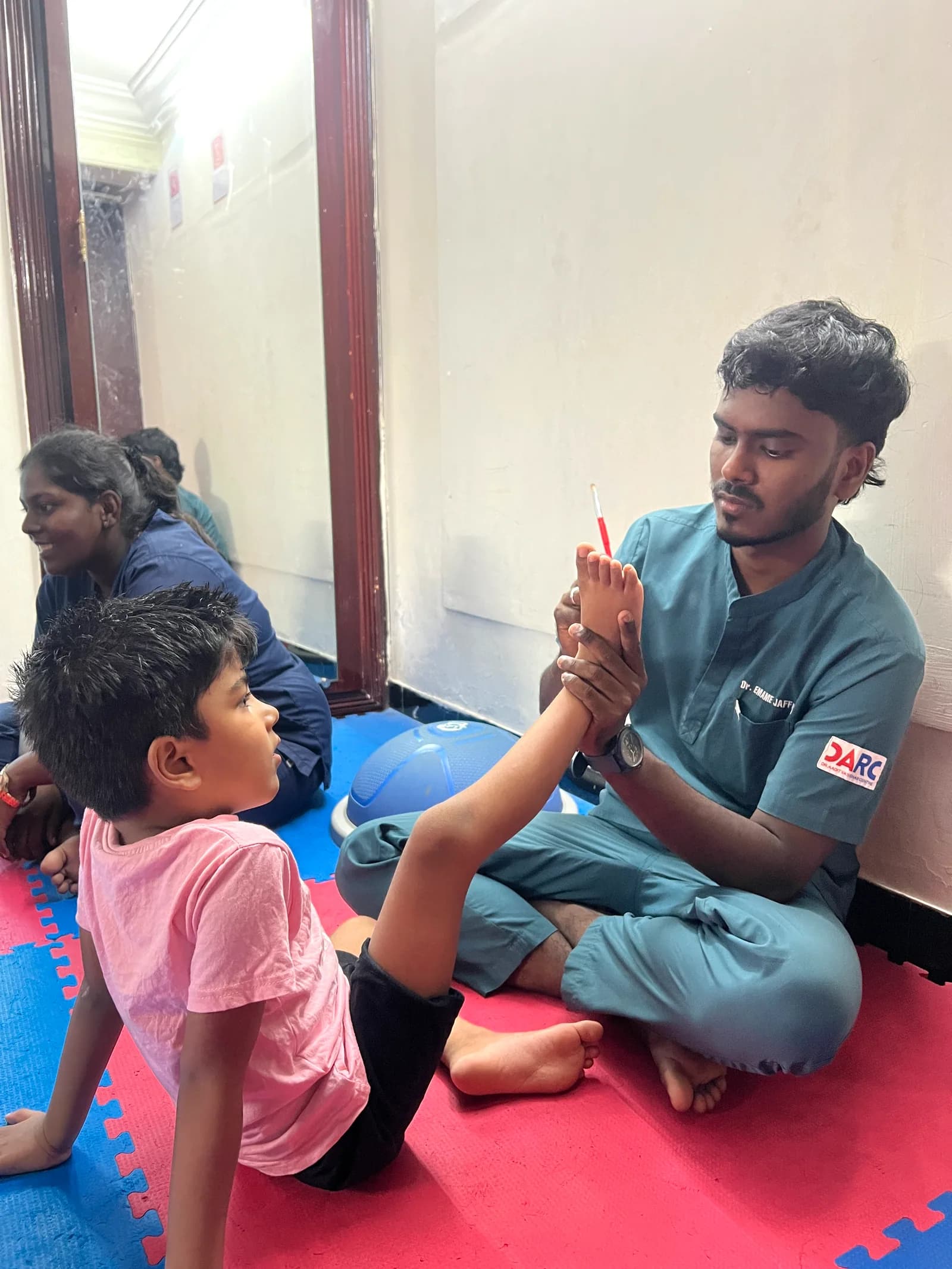
Your child may communicate comfort or discomfort through words, gestures, movement, facial expression or withdrawal. Ask how those signals affect the session. A good fit includes adapting the demands and environment when needed. You should be able to ask why an activity is being used and how the therapist will respond if your child does not want to continue.
A calm first visit is helpful, but one difficult appointment does not automatically mean the therapist is unsuitable. Look for respectful problem-solving over time. Does the clinician recognise when a task is too difficult, offer choices and explain changes? Be cautious if every distress response is dismissed as non-compliance or if you are told never to ask about what happens in a session.
Compare practical fit across Chennai
An excellent plan has to fit ordinary school days. Compare travel at the time you would actually attend, who can accompany your child and how the journey affects meals or rest. Do not choose a distant centre solely because it appears first in a search result. Ask what appointment options are available before building your weekly routine around a particular slot.
DARC has branches in Ashok Nagar and Pallikaranai. Families can use the branch pages to check the address, call the team and discuss assessment access. Choose based on your child's needs and the route you can sustain. A branch recommendation should come with practical details, not an unsupported promise that all appointments, specialists or programmes are available at every time.
Compare fees, reviews and promises carefully
Ask for separate explanations of consultation, assessment, recurring session and review fees. Check session duration, what parent guidance includes and what happens if you cancel or need a break. A price comparison is only meaningful when you know what each quote covers. Avoid paying for a long block of sessions before you understand the goals, review process and terms.
Reviews can show how families experienced communication, scheduling and support. They cannot predict your child's outcome. Look for specific descriptions rather than treating star ratings as clinical evidence. Promises of a cure, guaranteed speech or a fixed recovery date deserve scrutiny. Ask what evidence supports a proposed approach and what the clinician will do if the expected functional change does not appear.
Keep a short comparison record after each conversation
After speaking with a provider, write down the answers while they are fresh. Record the name of the regular therapist, what the assessment includes, the concern they propose to explore and the next step. Keep practical details separate: branch, appointment options, fees and travel. This prevents a polished website or a hurried phone call from becoming the only basis for your choice.
Make a second column for questions still unanswered. An open question does not automatically mean poor care; it tells you what to clarify before committing. If you are comparing two providers, ask each the same core questions and judge the clarity of the answers. Avoid adding up a numerical score that implies clinical certainty. A provider may be a strong fit for one need and a poor fit for another.
Include your child's experience in the record, especially after an in-person visit. Note whether the clinician noticed interests, responded to discomfort and explained the activity to you. Balance that observation with the assessment rationale and practical arrangements. You are choosing a working relationship around your child's daily life, so an understandable plan and respectful communication deserve as much attention as an impressive first impression.
Use the first conversation to make a clear decision
After the consultation, explain the proposed plan back in your own words. You should be able to say what the main concern is, which activity the team will work on, why that approach was chosen and when you will review it. If you cannot do that yet, request clarification. Questions are part of informed care, even when a clinician is experienced.
You do not have to choose a lifelong provider at the first meeting. Choose the next sensible step: an assessment, a referral, an agreed review or a short period of goal-led intervention. At DARC, use the consultation request form to share your concerns and ask which pathway is appropriate. Submitting an enquiry does not by itself confirm an appointment or commit you to ongoing therapy.
Common questions
Is there one best occupational therapist for every child?
No. Fit depends on the child's needs, the therapist's relevant experience, the assessment findings and the family's practical circumstances. Search rankings and awards cannot replace those checks. Compare how clearly the clinician explains goals, supports the child and reviews changes in daily life.
Should I choose a therapist or a therapy centre first?
Check both. A centre's systems matter for scheduling, safety and coordination, while the regular therapist matters for the day-to-day relationship and clinical decisions. Ask who will assess and treat your child, how supervision works and what happens if the treating therapist changes.
Can I ask for a second opinion?
Yes. Take the assessment summary, goals and questions to another appropriately qualified professional. A second opinion can help when recommendations are unclear, concerns fall outside one discipline or the plan is not producing useful change. Avoid changing plans repeatedly without sharing the previous observations.
Sources and further reading
Prepared by DARC from the resources below and existing service information. These sources do not endorse DARC or establish a result for an individual child.
- AOTA: Evaluation and assessment (opens in a new tab)
- AOTA: What is occupational therapy? (opens in a new tab)
- RCOT: Children, young people and families (opens in a new tab)
First published . Updated . Read our editorial policy or send a correction.
A clearer next step for your child
Share what is difficult in your child's day. The DARC team can explain the appropriate assessment pathway in Ashok Nagar or Pallikaranai.
No payment is collected on the request form. The team confirms the next step separately.